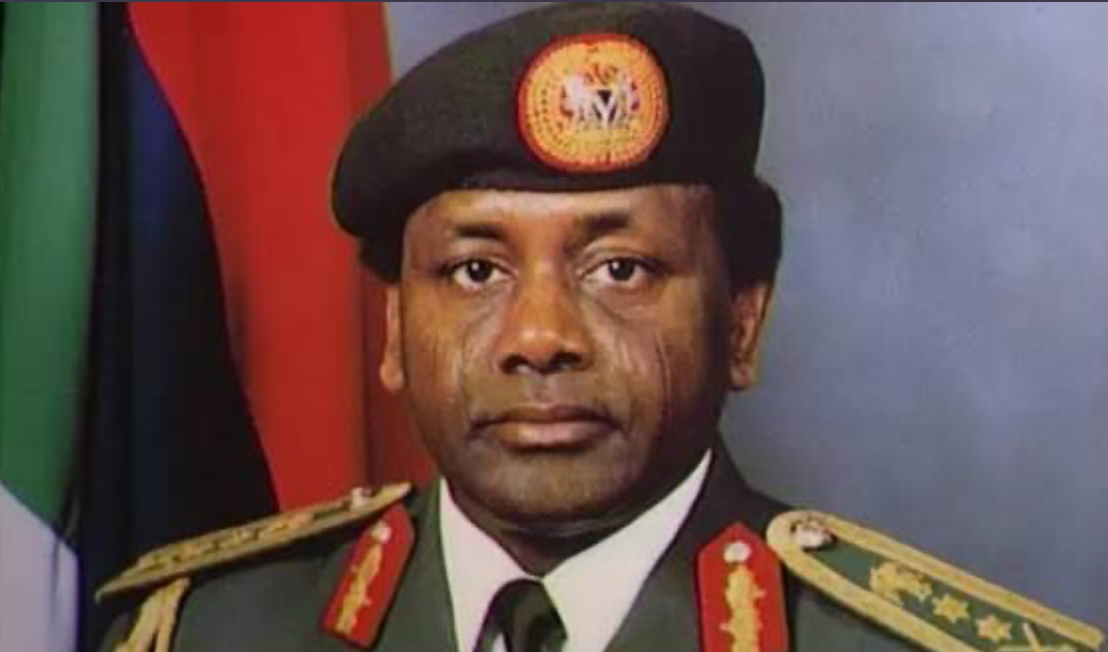
Preface
Nearly twenty-eight years after the death of Nigeria’s former Head of State, General Sani Abacha, a new claim has once again rekindled public interest in the circumstances surrounding his passing.
In a recently published book, former Assistant Director of the Department of State Services (DSS), Dennis Amachree, states that General Abacha died of cardiac arrest during an intimate encounter at the Aso Rock Guest House in 1998. This account has reopened public debate and challenged many of the conspiracy theories that have persisted for decades.
Readers are encouraged to examine the available evidence and form their own conclusions. Do you accept this account, or do you believe there is more to the story?
Tribute to Our Leader, Late General Sani Abacha (1943–1998)
People naturally perceive events differently. Their judgments are often shaped by their upbringing, environment, experiences, beliefs, and values. This reality is reflected in the popular saying that “one man’s meat is another man’s poison.” Diversity of opinion is therefore both inevitable and healthy.
The British fashion designer, Vivian Westwood, once observed:
«”If you believe in something because everybody believes it, you are not thinking.”»
The message is simple but profound. One should not accept or reject an idea merely because it is popular. Every responsible individual should carefully examine available evidence before arriving at an independent conclusion.
A similar lesson was expressed by the American President, Abraham Lincoln, in his famous Letter to His Son’s Teacher, where he urged:
«”Teach him not to follow the crowd.”»
These words embody an enduring philosophy. Independent reasoning is one of the greatest virtues of an educated mind. While it is wise to listen to the opinions of others, it is equally important to assess those opinions critically. At the same time, intellectual humility requires us to accept stronger arguments whenever they are supported by better evidence. As the saying goes, no man is an island.
Unfortunately, many people allow sentiment rather than reason to shape their opinions. Such sentiments may be rooted in ethnicity, religion, region, family ties, business interests, or political affiliation. Consequently, individuals often defend members of their own group regardless of whether their actions are right or wrong. History has repeatedly shown that misplaced loyalty frequently ends in regret, leaving many to say, “Had I known.”
General Sani Abacha, like every other Nigerian leader, served his country during a specific period and died while in office. Yet, unlike many of his predecessors and successors, he has remained one of the most controversial and widely criticised leaders in Nigeria’s history.
For decades, newspaper articles, magazines, documentaries, and public commentaries have largely focused on allegations associated with his administration. These include the circumstances surrounding his death, allegations of human rights abuses, alleged involvement in phantom coup trials, and accusations of financial misconduct. Consequently, relatively little public attention has been devoted to examining the developmental policies and achievements of his administration.
As a result, many people have come to view General Abacha solely through the lens of these allegations. Whether that perception represents the complete historical record is a question that deserves careful and objective examination.
What makes the situation even more remarkable is that some individuals who once worked closely with General Abacha later became among his strongest critics. Many who praised his leadership while he was in office subsequently condemned him in the strongest possible terms after his death.
This raises an important philosophical question: Does loyalty end with the death of a friend or political associate?
Former President Olusegun Obasanjo captured this phenomenon in 1987 when he observed:
«”Throughout history, hired and hosanna singers have not only been the undoing of those whose praise they sang, but in most cases have also been the first to betray them and cry, ‘Crucify him,’ while yesterday’s constructive critics eventually became trusted friends.”»
This quotation, reproduced in Ebenezer Babatope’s Not His Will, aptly illustrates how political loyalties can shift with changing circumstances.
The author recognises that political realities often influence public opinion. Individuals may change positions for personal, political, or economic reasons. Such realities form part of Nigeria’s complex political history.
Against this background, this book, Abacha: The Steadfast Guardian of a Nation (1993–1998): The Vision and Mission of an Accomplished Patriot, seeks to present an alternative perspective on General Abacha’s administration.
The objective of this work is not to rewrite history but to encourage readers to re-examine widely held assumptions in the light of publicly available evidence. The facts discussed in this book are drawn from newspapers, magazines, published materials, public records, discussions with informed individuals, and the author’s personal reflections.
The author does not claim to have been an insider within General Abacha’s administration or to possess privileged information about events that occurred during his tenure. Rather, this book represents an attempt to analyse historical events objectively using available documentary evidence and reasoned interpretation.
The principal aim is to respond to allegations that the author considers inaccurate or incomplete and to correct what he believes are misconceptions surrounding General Abacha’s legacy. This should not be interpreted as portraying General Abacha as flawless. Like every human being, he possessed strengths and weaknesses. The purpose is simply to present a broader historical perspective that allows readers to evaluate both his achievements and his shortcomings fairly.
The concluding chapters of this book examine what the author regards as the major achievements of General Abacha’s administration during his nearly five years as Nigeria’s Head of State and Commander-in-Chief of the Armed Forces.
The publication of Dennis Amachree’s account regarding the circumstances of General Abacha’s death has once again stimulated public discussion about his life and legacy. It is hoped that this renewed interest will encourage more balanced historical scholarship.
This book is intended for readers who genuinely wish to understand the complex legacy of General Sani Abacha. The author respectfully encourages readers to examine the evidence presented, compare it with other historical accounts, and arrive at their own independent conclusions.
Finally, the author welcomes constructive criticism and scholarly observations. Although trained as an education graduate and now presenting his fourth published work, he does not claim perfection in the use of the English language. Any corrections relating to grammar, style, or factual accuracy will be sincerely appreciated and will contribute to improving future editions.
Mallam Isah Alhaji Ibrahim
24 July 2026