The true character of a leader is not found in the loudness of their rhetoric, but in the consistency of their convictions and their ability to remain composed under fire.
Recent events in Abia State have highlighted a striking contrast between the seasoned statesmanship of Senator Orji Uzor Kalu and the reactionary posturing of the current state administration.
While Governor Alex Otti’s camp has resorted to emotive language and personal swipes, Senator Kalu has stood firm with a strategic depth and emotional intelligence that come only from decades of navigating the highest levels of governance.
This disparity is more than a simple political disagreement; it is a masterclass in the maturity required to lead a people effectively while maintaining a steady hand on the pulse of the nation.
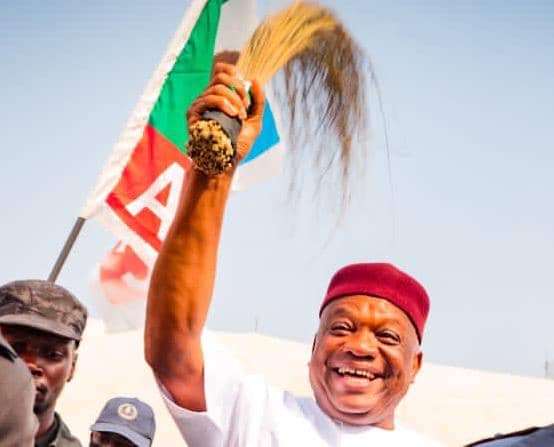
Senator Kalu’s recent and bold affirmation of his commitment to the All Progressives Congress (APC) is a testament to his character as a principled leader.
In a political culture where many change their colors with the seasons, Kalu’s unwavering loyalty to his party and his open support for President Bola Ahmed Tinubu’s re-election in 2027 should be seen for what it is: a standard exercise of democratic rights and a fulfillment of partisan duty.
As a ranking leader of the APC, his primary goal is to build a formidable political structure in Abia State that can deliver tangible progress. To frame this dedication as a “threat” or an act of “war” is to misunderstand the very nature of a healthy democracy.
Democracy is built on a competition of ideas, not on the coronation of a single individual. By standing his ground, Senator Kalu is ensuring that Abia does not slide into a monolithic political echo chamber, but instead remains a place where diverse visions for progress can flourish.
There is a profound lesson for the current administration in what many now call the “Kalu Model” of political longevity. Senator Orji Uzor Kalu has remained a cornerstone of Abia’s political history since 1999 because his relevance is not built on fleeting social media trends or temporary waves of protest.
Instead, his influence is anchored in decades of grassroots connection and a record of delivering federal infrastructure to the doorsteps of his constituents in Abia North. While the present government arrived on a surge of 2023 sentiment, Kalu’s endurance is rooted in a history of winning elections through every political climate.
Even when faced with hostility, he has consistently offered olive branches, suggesting that the state’s future is best served by unity and alignment with the progressive vision of the APC.
These gestures of friendship were not signs of weakness, but acts of high-level statesmanship aimed at regional stability.
The reality of the 2023 governorship election further underscores Kalu’s indispensable role in the state’s political fabric. It is a well-known fact within political circles that during the critical hours preceding the election, key stakeholders sought Kalu’s influence to ensure a stable outcome.
Reports from his Media Office, led by George Maduka, have openly challenged the Governor to deny his late-night visit to Kalu’s Igbere residence on the eve of the polls. Furthermore, prominent figures who coordinated the Labour Party’s campaign, such as Chief Umeh Kalu, SAN, were in active consultation with the Senator during that pivotal time.
The logic is simple: if Kalu were as “irrelevant” as some media aides now claim, there would have been no need for such high-stakes visits or strategic discussions. His home in Igbere has always been a sanctuary for dialogue because he is a leader who understands how to bridge divides for the greater good of Abia.
As the political landscape shifts toward 2026 and 2027, the internal cracks in the opposition are becoming impossible to ignore. While the APC in Abia remains a solid and unified house under Kalu’s guidance, the Labour Party is grappling with significant disarray.
The fact that several local government chairmen elected under the Labour Party platform are already seeking refuge in other parties like the ZLP and YPP speaks volumes about the fragility of their current hold on power.
Senator Kalu, observing this, has rightly pointed out that governance requires more than just social media hype or the superficial repainting of existing structures. True leadership involves industrial rebirth, economic inclusion, and the efficient use of the significant federal resources that the APC-led central government has made available to all states.
Kalu’s critique of the current administration’s performance is a call for accountability, reminding all public servants that the people of Abia deserve leaders who prioritize progress over personal vendettas or petty name-calling.
Ultimately, Senator Orji Uzor Kalu remains a pillar of stability because he approaches leadership with a “Big Tent” philosophy. He understands that the offices of Senator and Governor are temporary trusts granted by the people, and his loyalty lies first with the progress of the state and his party’s vision for a greater Nigeria.
His refusal to abandon President Tinubu in 2027 is a mark of a man who values his word and his political alliances above convenience. Kalu is not a politician who hides behind aides to issue insults; he is a leader who invites direct and honest engagement.
His advice to the current administration to “quit confrontation and govern” is the wisdom of an elder statesman who knows that the window of opportunity to serve the people is always closing.
As the APC continues to grow in strength across Abia, Kalu stands as a guardian of democratic integrity, proving that experience, loyalty, and a heart for the people are the most enduring tools for building a prosperous future.
Rubby Obinna
January 6, 2026.