From Kenneth Udeh, Abuja
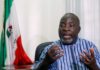
Chairman of the Senate committee on South-East Development Commission (SEDC) Senator Orji Uzor Kalu has firmly stated that the spate of defections into the All Progressives Congress (APC) is not a result of President Bola Ahmed Tinubu’s personal lobbying but rather a testament to the strength, progress, and appeal of the ruling party.
Speaking during a one-on-one interview on Channels Television’s Politics Today on Monday, Kalu, a former governor of Abia State and current senator representing Abia North, dismissed claims that the President has been involved in orchestrating high-profile defections from rival political parties.
According to Kalu, those crossing over into the APC, including Governors and National Assembly members, have done so “entirely of their own volition,” not under any form of pressure or invitation from the presidency.
The former Senate Chief exonerated President Tinubu saying;
“President Tinubu never asked anyone to join or leave their party,” he stated emphatically. “Even when you tell him, ‘let’s convince some people to join our party,’ he will say no.”
Pressed on who is driving the mass movement of politicians into the APC, Kalu pointed to intra-legislative and peer-level influence: “It’s their colleagues,” he said; “They are not running away from anything or hiding; they are running to be in the winning party. It’s not good to be in a small party.”
He went further to declare that opposition parties are fast losing relevance in the national political equation. “PDP is a small party.
As far as I’m concerned, they are gone. Labour is not in existence,” he said, in a blunt assessment of the present political terrain.
Kalu’s remarks come amid increased political maneuvering and shifting alliances, especially in the lead-up to the 2027 general elections. His comments sought to dispel the popular narrative that the APC is acting as a “safe haven” for embattled politicians fleeing accountability.
Instead, he argued that the party’s growing attractiveness is based on its performance and long-term vision for Nigeria.
“We are a political party, and there must be activities,” Kalu noted, referencing the recent midterm assessment by APC stakeholders. “The APC remains strong, united, and focused on national development.”
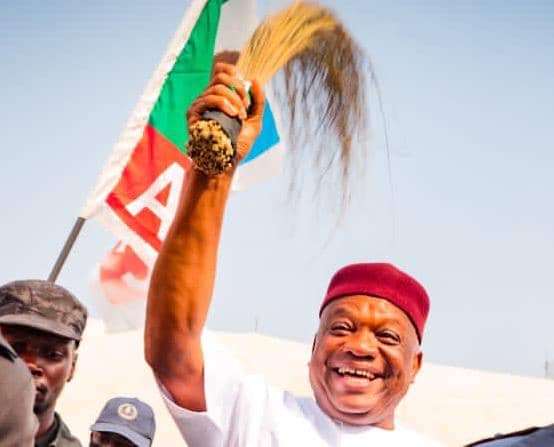
Kalu also defended his public support for President Tinubu, including his choice to wear a Bola Tinubu 2027-branded outfit, which generated widespread media attention. “There is freedom of association and freedom of speech.
I have the right to wear what I like and say what I want to say,” he said. “I was in the Senate doing my legislative job when journalists ran over me because of my dress.”
He insisted that speaking about 2027 at this stage was not premature or insensitive, but a natural part of political party life. “We must assess and organize our party mid-term. Nigerians must understand that politics is a continuum,” Kalu explained.
Senator Kalu also used the interview to defend the Tinubu administration’s economic reforms, particularly the removal of fuel subsidies and efforts to stabilize the exchange rate.
He admitted that the reforms have created hardship, even for himself as a businessman, but emphasized that they are necessary corrections.
“I work hard for every penny. The removal of the subsidy affected me because I have two tank farms. But Tinubu made the best decision,” he said. “The money from subsidies must now go to the rightful owners, the Nigerian people.”
Kalu, who claims to employ over 14,000 Nigerians across his private enterprises, warned that some of the resistance to Tinubu’s reforms comes from entrenched elites who profited from the old system. “Those fighting Tinubu are those who speculated on the dollar and earned millions by doing nothing.”
He also raised concerns about the open use of U.S. dollars in real estate and everyday transactions in Nigeria, describing the practice as a threat to national economic stability. “No serious country allows its economy to be run on another country’s currency like this,” he said, urging for strict control measures like those in South Africa, India, and the UK.
While urging Nigerians to be patient, Senator Kalu emphasized the long-term nature of Tinubu’s reforms and compared Nigeria’s journey to that of countries like Singapore under Lee Kuan Yew.
“Things are getting better. Difficult times don’t get better in one day,” he said. “When the former president introduced austerity measures in the past, it was the same pain. Before, we ran an open economy, now we are building an economy that must have shape.”
He concluded with an emotional appeal to the public: “I want to beg Nigerians to have more patience. Even personally, I go through a lot to pay my workers.